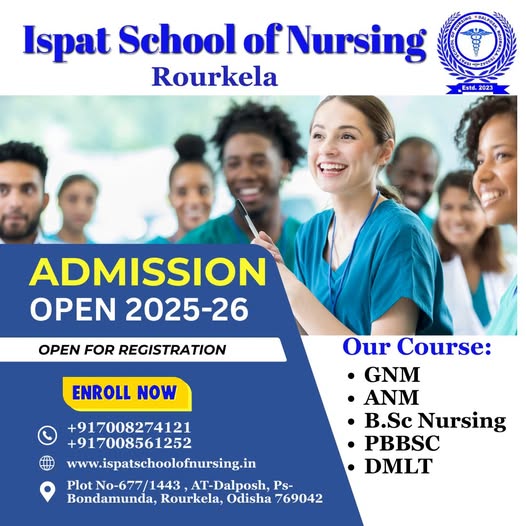
Choosing the right institution for your nursing education is critical. The General Nursing & Midwifery (GNM) course is one of the most respected pathways into clinical nursing, and not just in terms of immediate employment: it shapes your future as a caregiving professional. In Rourkela, the Ispat School of Nursing (also known as Nurses Training Institute, Ispat General Hospital, Sector‐19 / Ispat School of Nursing at Dalposh) stands out as an excellent choice. This post explains why the GNM program here is considered among the best, what the course offers, who the faculty are, what facilities you’ll get, admission & fees, and what students can expect by way of opportunities after completing the course.
What is GNM?
GNM stands for General Nursing & Midwifery. It’s a diploma course that imparts knowledge and skills in multiple areas: patient care, midwifery, community health, medical & surgical nursing, mental health, child health, etc. The duration is typically three years, sometimes with added internship/practical training. The aim is to produce well‐rounded nurses who can work in hospitals, clinics, community health, and other settings.
Overview of Ispat School of Nursing
Located in Rourkela, Sundergarh district, Odisha, Ispat School of Nursing is part of the healthcare and educational infrastructure tied with Ispat General Hospital (IGH), Sector-19. It is registered with the relevant regulatory bodies (like the Indian Nursing Council / state nursing council) and has established credibility over decades. It also appears in official listings of nursing institutions under private institutions offering GNM in the region.
Why Ispat’s GNM Course is Among the Best in Rourkela
Here are the reasons that make the GNM program at Ispat particularly strong.
1. Strong Academic Results & Reputation
- Students of Ispat (or its Nurses Training Institute IGH) have made significant marks in state‐level GNM examinations. For example, a student obtained 2nd in the state in the GNM Board Examinations (January 2025), with an outstanding score (88.89%).
- Such achievements reflect not only student effort, but quality teaching, good preparation, and a serious commitment to standards.
2. Long‐standing Institution and History
- The Nurses Training Institute, Ispat General Hospital has been functioning for many years, which means experience in imparting nursing education, refinement of course delivery, and a mature support infrastructure.
- Being part of the hospital environment (IGH) ensures that theoretical learning is complemented with clinical exposure, which is essential in nursing.
3. Comprehensive Curriculum & Clinical Exposure
- The GNM course at Ispat includes all typical core subjects: medical surgical nursing, midwifery, child health, mental health, community health, etc. (this is standard in GNM).
- More importantly, because the institute is tied to a major hospital, students gain hands‐on experience through clinical rotations. Being in Rourkela Steel Plant’s hospital adds exposure to varied cases.
- Also, the practical/training facilities are stronger than what many stand‐alone institutions can offer.
4. Affordability & Transparent Fee Structure
- One of the hurdles many students face is cost. At Ispat, the fees are relatively moderate when compared with many private nursing / paramedical institutions. For example, the first‐year total fee for GNM (including miscellaneous and hostel where applicable) is ~ ₹58,700 for first year. Second and third years are also lower.
- Having a public institution or semi‐public backing helps keep the cost reasonable, which allows more students to afford quality nursing education without compromising on essentials.
5. Infrastructure & Facilities
- As a hospital‐attached training institute, Ispat School of Nursing gives students access to real wards, operation theatres, emergency departments, etc., providing exposure to a wide range of patient care scenarios.
- Hostels, labs, library facilities, skill labs, and mentorship by experienced nurses and doctors are part of the package. While I don’t have every detail, such features are typical for hospital‐based nursing schools of this nature, and Ispat has in its listing hostel facilities in other related institutes.
6. Admission Process & Recognition
- The GNM program is included in the seat allotment / counseling rounds by Odisha’s health education authorities, which ensures fairness, transparency, reservation policy, and official recognition. For example, in recent counseling rounds, many seats were allotted to students who listed Ispat among their choices.
- The institution is listed among the private institutions approved to offer GNM in Sundargarh / Rourkela.
Admission, Eligibility & Fees
Here are the common details prospective students need to know about entering GNM at Ispat.
| Item | Detail |
|---|---|
| Eligibility | Typically, students must have passed 10+2 (or its equivalent) with certain minimum marks (often 40% or more). There may be specific subject requirements depending on state policies. Also, there might be age limits, medical fitness tests, etc. (You’ll need to check the current prospectus or state counselling brochure for precise details.) |
| Admission Process | Through Odisha’s state counselling / seat allotment for nursing programs. Applicants list preferences, go through merit ranking, etc. Ispat is part of this process. |
| Duration | The GNM course is 3 years long (sometimes ~3.5 years including internship depending on state policy). Ispat’s seems standard. |
| Fees | First year fee (tuition + misc + hostel if applicable) ~ ₹58,700. Second and third years cost somewhat less (just tuition + misc) ~ ₹55,000+ depending on accommodations and additional charges. |
| Seat Capacity & Reservation | The number of seats, reservation for SC/ST/OBC, etc., follow state norms. Students from local districts often have reservations and priority. |
Student Experience & Challenges
While Ispat offers many advantages, here are some things to consider, based on general nursing student feedback (not all specific to Ispat).
Pros
- Real patient contact from early semesters helps build confidence.
- Exposure to variety of clinical cases, thanks to hospital setting.
- Faculty who are familiar with local community health issues and able to orient students properly.
- Peer learning, structured labs, and recognized qualification (GNM) that allows registration as nurse / midwife.
Cons / Things to Keep in Mind
- Workload is high. Nursing involves long hours, both in studies and clinical practicals.
- Emotional demands: dealing with sickness, critical patients, death, etc., can be stressful. Support systems matter.
- Infrastructure may have limitations: lab equipment, hostel accommodations, or facilities might occasionally be under strain due to many students / resource constraints.
- Staying updated with changing regulations: nursing curricula and regulatory norms do get updated, so prospective students need to ensure they meet the latest requirements for registration.
What Happens After GNM at Ispat
Completing GNM from a well-regarded institute like Ispat opens several paths.
- Job Opportunities
- Works in hospitals (private or government) as staff nurse, midwife, community health nurse.
- Employment in clinics, public health departments, NGOs.
- Because of its recognized status, it’s easier to get registered, and employers consider credentials from Ispat favorably.
- Further Studies
- Pursue B.Sc Nursing (lateral entry or bridging courses) for those who wish to upgrade qualifications.
- Specialised training: ICU, neonatal care, psychiatric nursing etc.
- Certifications in paramedical or allied health specialisations.
- Service in Rural / Community Health
- Odisha has many rural/tribal communities; nurses with GNM training are often needed in primary health centres (PHCs), community health programs, vaccination campaigns, etc.
- Personal Growth & Skill Development
- Apart from medical skills you learn communication, empathy, emergency response, teamwork, adaptability.
- Many students go on to leadership roles or become educators themselves.
Testimonials / Success Stories
Including quotes or stories of students who have done well can make the case stronger. For example:
“I had doubts before joining GNM, but after being part of Ispat’s clinical rotations I feel confident – the exposure to real patient care and the teachers’ dedication made a huge difference.”
Ms. Jyotirmayee Pattnaik, a 73rd batch student, who became 2nd in the state GNM board exam, says: “The never-give-up attitude instilled by my mentors was key to my performance.”
Why Choose Ispat Over Other Options in Rourkela
Rourkela offers several nursing schools, but here’s how Ispat stands out in comparison:
| Feature | Ispat School of Nursing | Other Private Institutions* |
|---|---|---|
| Affiliation with a large hospital (IGH) for clinical exposure | ✅ High | Some do, some don’t |
| Academic reputation / top exam performance | ✅ Strong track record | Varies; fewer with consistent top scores |
| Fee affordability | ✅ Moderate / Reasonable | Often higher for similar offerings |
| Transparent / regulated admission through state counselling | ✅ Yes | Some private may have different or additional criteria / hidden charges |
| Variety of departments, exposure to diverse cases | ✅ Good | Some may have limited specialty exposure |
*This is general; individual institutes may be better or weaker in specific areas.
How to Prepare for Admission & Succeed in GNM at Ispat
If you plan to join Ispat’s GNM, here are tips to make the most of it:
- Prepare Academics Well
- Strong foundation in science (especially biology) helps.
- Work on communication skills (English, local languages) since nursing requires clear communication.
- Visit & Talk to Current Students
- Find out about hostel life, labs, actual clinical exposure—sometimes expectations differ from reality.
- Understand faculty support: how approachable teachers are, how lab/practice supervision works.
- Be Ready for Clinical Work
- Be prepared for long hours, sometimes shifting schedules, practical hands-on work.
- Learning by doing is essential—lab work, clinical rotations, skill labs.
- Stay Updated on Regulatory / Exam Norms
- Ensure your documents are in order (10+2 mark sheets, medical fitness, etc.).
- Know the counselling / allotment schedule. Deadlines matter.
- Make Use of Support & Resources
- Use library, study groups, extra classes, mentorship where available.
- Seek internships or workshops outside college if possible to broaden experience.